
The company had sold 50 units of SX4 sedan in August 2014.

Automotive (auto) and auto ancillary stocks have been in the fast lane thus far in 2023-24 (FY24), with the National Stock Exchange Nifty Auto Index surging nearly 27 per cent, outperforming the Nifty50, which has gained roughly 11 per cent during this period. The top-gear performance of auto stocks at the bourses, according to A K Prabhakar, head of research at IDBI Capital, has been triggered by the premiumisation of products across vehicle manufacturers, which has seen vehicle sales remaining relatively stable. "It is not about higher sales figures now, but about premiumisation.

'Interim Budget has ignited the entrepreneurial spirit.'

The new Duster will go head-to-head with popular models like Hyundai Creta, Kia Seltos, Volkswagen Taigun, Skoda Kushaq, Maruti Suzuki Grand Vitara, Toyota Urban Cruiser Hyryder, MG Astor, etc in the highly competitive mid-size SUV segment.

Toyota Kirloskar Motor on Tuesday said it is recalling around 994 units of its recently launched mid-sized sports utility vehicle Urban Cruiser Hyryder to fix a faulty seat belt part. In a statement, the company said it has initiated a voluntary recall campaign for certain Urban Cruiser Hyryder units to investigate for a possible issue with front seat belt shoulder height adjuster plate assembly. Around 994 vehicles of the specified models may have been impacted by this concern, Toyota Kirloskar Motor (TKM) said in a statement.

Passenger vehicle exports from India increased 43 per cent in FY22, with Maruti Suzuki India leading the segment with dispatches of over 2.3 lakh units, as per the latest data by industry body SIAM. The total passenger vehicle (PV) exports stood at 5,77,875 units in 2021-22 fiscal, as compared to 4,04,397 units in 2020-21. Passenger car shipments saw 42 per cent growth at 3,74,986 units, while utility vehicle exports rose 46 per cent at 2,01,036 units during the last fiscal, the data by the Society of Indian Automobile Manufacturers (SIAM) showed.

http://im.rediff.com/money/2023/jul/20uv.jpg

Equity benchmark indices Sensex and Nifty on Friday reversed their six-session losing streak and rebounded more than 1 per cent on value buying in auto, IT, financial and energy stocks. Better than expected quarterly financial results of corporates also boosted investor sentiments even as uncertainties persisted over the escalating tensions in the Middle East, according to analysts. In a largely range-bound trade, the 30-share BSE Sensex rose 634.65 points or 1.01 per cent to settle at 63,782.80 points.

Domestic passenger vehicle dispatches witnessed a 13 per cent year-on-year rise in April as demand remained robust across segments, industry body Siam said on Friday. The total passenger vehicle dispatches from companies to dealers rose to 331,278 units last month compared to 293,303 units in April 2022. Market leader Maruti Suzuki India dispatched 137,320 units to dealers last month against 121,995 units in April last year.

Equity benchmarks recovered most of their intra-day losses and ended marginally lower on Tuesday amid buying in index majors Reliance Industries and Tata Consultancy Services. Helped by last minute buying activity in some of the index heavyweights, the 30-share BSE benchmark Sensex managed to trim most of its early declines and ended lower by 103.90 points or 0.17 per cent at 61,702.29. During the day, it had tumbled 703.51 points or 1.13 per cent to 61,102.68.

Code-named Pelican, bigger hatchback with new petrol and diesel engines may hit the road next year.
The country's largest carmaker Maruti Suzuki India on Thursday reported 14 per cent increase in total wholesales at 159,044 units in November. The company had dispatched 139,184 units to dealers in November 2021, MSI said in a statement. Last month, the company's domestic sales rose 18 per cent to 139,306 units as against 117,791 units in November 2021, it added.

Buying a car, particularly a diesel-powered one, is set to pinch the customers' pockets even more from the next financial year, as the second phase of Bharat Stage VI (BSVI) emission norms kicks in. The rules require cars to be compliant with real driving emission (RDE) norms, which measure pollutants emitted by cars while they are being driven on the road, unlike in a laboratory test. The norms may increase the cost of producing diesel vehicles by nearly Rs 75,000 to Rs 80,000, and petrol-powered ones by Rs 25,000 to Rs 30,000, analysts said.

Dealers across brands are slashing prices by Rs 20,000 to over Rs 1 lakh, depending on the car model.

From the Sensex pack, Tata Steel plunged nearly 5 per cent. Other major laggards were Tata Motors, State Bank of India, Bajaj Finserv, Reliance Industries, Wipro, IndusInd Bank, Larsen & Toubro and Maruti Suzuki.

'Nearly all companies are extending festival offers for entry-level, sedan, and hatchback segments.'

Many say Tata Motors has perhaps paid the price for being too ambitious.
Currently, Maruti Suzuki has 14 car brands, but it has decided to expand into some new segments.

A clutch of automakers including Maruti Suzuki, Hero MotoCorp, Mercedes Benz India, Eicher Motors, TVS Motor, and Isuzu Motors India announced they had got the clearance from the governments of the states they operate in to resume operations.

Tata Motors is giving a much stronger focus on the design of its cars, from planning product life cycle in a better way to incorporating subtle Indian elements to its future models.

MSI's exports, however, fell by 13 per cent to 10,554 units.
Carmakers Mercedes-Benz, Audi, Renault, Kia India and MG Motor on Wednesday announced plans to hike vehicle prices from January to partially offset the impact of rising input costs. They join the likes of market leader Maruti Suzuki India and Tata Motors, which have also made the year-end announcements to raise prices from next month. Audi India said it will increase prices of its entire model range by up to 1.7 per cent, while Mercedes-Benz India noted it will hike the prices by up to 5 per cent from January 1.

Today, Suzuki depends on Maruti for its place in the world

Amid better semiconductor chip supplies, the Indian automotive industry posted an 8 percent growth in production of vehicles across categories for the month of May, with three-wheelers (20 per cent) and passenger vehicles (16 per cent) leading the pack. Exports, however, dipped 21 per cent at an industry level. The industry also recorded its highest-ever May wholesales of domestic passenger vehicles (334,802 units), riding on high demand for sport utility vehicles (SUVs) and better supplies of semiconductor chips.
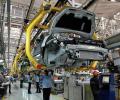
The K-shaped economic recovery in India from the pandemic slowdown shows in corporate results as well. The automobile sector, which represents big-ticket consumption, continues to do well and has increased its share in corporate revenues and profits while fast-moving consumer goods (FMCG) companies that sell low-ticket consumer goods are struggling with poor sales and earnings growth. The share of the automobile sector, including makers of auto ancillaries, in corporate net sales rose to a 10-quarter high of 10.05 per cent during July-September 2023 (Q2FY24) from 8.94 per cent a year earlier and 9.75 per cent in Q1FY24.

Jimny will be priced between Rs 12.7 lakh and Rs 15.05 lakh.

Maruti Suzuki India (MSIL) - the market leader in small cars - is eyeing the top spot in the sports utility vehicle (SUV) segment within a year - with a 33 per cent share of the pie. The company has been selling two SUVs - the Brezza and the Grand Vitara - and will start deliveries of the Jimny and the Fronx from March-end, and has set a target of growing its share from the current 11.5 per cent of the SUV market to 33 per cent by the end of 2023-24. The SUV segment is roughly about 42 per cent of the total passenger vehicle market, or around 1.3 million units.
Seven auto companies lost share in the current year because of different reasons.

After a long delay, Thailand opened its twice-postponed Bangkok international motor show to the public as coronavirus restrictions eased, with nearly all attendees wearing masks and face shields.

The previous May peak was observed in 2018 when the domestic PV wholesales stood at 301,238 units.

'I think some of us, like Mukesh Ambani, myself and those of us who head industrial units, ought to really focus on what we can really do to make the world a safer place, maybe 50 or 100 years from now.' 'For instance, how can we deal with climate change and global warming, right now?' 'The effects of it may not be felt now; in fact, we may pay a price for it today, but it will help the generations to follow.'

Operating margins have been the primary driver of corporate earnings in India in recent quarters, despite revenue growth suffering from weak consumer demand. Companies across sectors have reported a sharp improvement in earnings before interest, tax, depreciation, and amortisation (Ebitda) margins over the past two years, benefiting from lower commodity and energy prices. Higher margins more than compensated for slower revenue growth, resulting in double-digit growth in net profit for five consecutive quarters.

Apart from around 40 Japanese companies and five global vendors of MG Motor India, many other biggies are eyeing Gujarat for either greenfield opportunities or brownfield expansion.

MSI said compact sedan Dzire Tour stood out as sales rose by over two-fold during the month under review to 3,370 units as against 1,299 in July 2014.

Benchmark equity indices Sensex and Nifty closed higher on Friday after two days of fall, helped by buying in metal, telecom and auto stocks amid a firm trend in global markets. Automakers led by Maruti Suzuki India, Hyundai, Mahindra & Mahindra reporting robust wholesales of passenger vehicles and GST collections crossing Rs 1.50 lakh crore for the third straight month in May also added to the optimism. The 30-share BSE Sensex climbed 118.57 points or 0.19 per cent to settle at 62,547.11.
Automobile retail sales in India rose 11 per cent in September as better supplies from manufacturers enabled dealers to ramp up customer deliveries amid the ongoing festive period, Federation Of Automobile Dealers Associations said on Tuesday. Last month, total retail sales stood at 14,64,001 units as compared to 13,19,647 units in September 2021. FADA noted that October is expected to witness even better overall sales due to the festive season further gathering steam.

India's corporate sector is likely to report a slowdown in revenue growth and earnings for the July-September 2023 period (Q2FY24), according to earnings estimates by brokerages, after the country's top listed companies posted higher than expected profits for the first quarter. The combined net profit of Nifty50 companies, based on brokerage estimates, is expected to have grown by 19.6 per cent year-on-year (Y-o-Y) to Rs 1.75 trillion in Q2FY24 - a sharp deceleration from 37.6 per cent Y-o-Y growth in the combined earnings of index companies in the April-June 2023 period. According to estimates, the combined earnings in the second quarter would be down 8.8 per cent on a quarter-on-quarter (Q-o-Q) basis and the lowest in the past three quarters.

The new year will see a line of hatchbacks (including compact SUVs) hit the Indian roads. Rajesh Karkera/Rediff.com offers a peek.

Only five of India's top 20 car models have seen a reduction in wait times over the past year.

'Some of the launches may get deferred due to the semiconductor shortage, which is unlikely to get resolved before the second half of 2022.'
